E-Cigarettes Are No Longer an “Innovative Consumer Product”: The End of a Generation’s Business Logic
For a long time, the e-cigarette industry was accustomed to defining itself with one term: innovative consumer product. It implied technological iteration, flavor innovation, and enhanced user experience. It also represented a classic entrepreneurial narrative: young, fast, and full of opportunity.
But by 2026, this narrative is increasingly difficult to sustain.
E-cigarettes still exist, and market demand hasn’t disappeared. However, the industry is undergoing a deeper identity transformation: It is no longer treated as an innovative consumer product free to experiment and make mistakes, but is being classified as a special category bearing high responsibility and subject to stringent regulation.
This is not just a slogan; it marks the end of a generation’s business logic.
1. What Did “Innovative Consumer Product” Mean Back Then?
The initial success of e-cigarettes heavily relied on the regulatory space afforded by the “innovative consumer product” framework.
Within this framework, the industry gained four key advantages:
First, regulatory tolerance. Innovative industries are often allowed to develop first and be regulated later. Products could enter the market, with rules being established afterwards, providing early companies with a significant window of opportunity.
Second, room for trial and error. Products could be iterated quickly, and sales channels could be expanded rapidly. Even failures were often seen more as business risks than as regulatory issues.
Third, a growth-first logic. Market size, user numbers, and channel speed were the core metrics, with compliance often viewed as a “postponed task.”
Fourth, a viable entrepreneurial narrative. Concepts like “disrupting traditional tobacco,” “technological alternative,” and “young consumer upgrade” were not only accepted by the industry but also partially endorsed by the market and investors.
In such an environment, individual judgment and execution speed were immensely amplified. Whoever spotted the trend first and was willing to bet big had the potential to succeed.
This was a classic development path for an innovative consumer product.
2. The Real Turning Point: Identity Shift from “Innovation” to “High Responsibility
In recent years, many in the industry have interpreted the changes as the “market getting tougher” or “regulation tightening.” But understanding it only this way misses a more critical shift:
The institutional identity of e-cigarettes is undergoing a fundamental transformation.
Globally, e-cigarettes are being repositioned as a highly sensitive consumer category, touching upon public health, youth protection, tax systems, and the interests of the traditional tobacco landscape. This gradually moves them from the “innovative consumer product” category towards a highly responsible regulated category, similar to tobacco, alcohol, or pharmaceuticals.
Once this identity shift is complete, the industry’s underlying logic will completely flip.
The innovative consumer product era emphasized “enter first, regulate later,” while the high-responsibility category emphasizes “license first, then enter.”
Innovative consumer products allow for multiple entities to coexist and quick trial and error, whereas high-responsibility categories tend to compress the number of players and reduce uncertainty.
In the former, growth is seen as a positive signal; in the latter, excessively rapid growth might itself be viewed as a source of risk.
This means competition in the e-cigarette industry is no longer just about products and channels, but is gradually becoming a form of institutional competition.
3. Reconstructing Business Logic Under Institutional Competition
When an industry enters a phase of institutional competition, the first thing to change is not the market size, but the structure of its participants.
In the past, success in the e-cigarette industry often came from:
Quickly judging trends and seizing channel opportunities;
Launching hit products and covering the market with speed.
These capabilities were extremely important in the innovative consumer product stage and did indeed build several companies.
But in the stage of institutional competition, the factors determining a company’s long-term survival begin to shift towards:
Sustained compliance capability and risk-bearing capacity;
The ability to coexist long-term with the regulatory system and adapt to rule changes.
This is a completely different set of competencies.
It no longer rewards short-term bursts, but values long-term stability; it no longer encourages a multitude of players, but tends to retain a few controllable entities.
In other words, the industry’s core question shifts from “Who can grow big?” to “Who can stay?”
4. The End of a Generation’s Entrepreneurial Logic
Many e-cigarette practitioners still think using the old paradigm: believing that as long as they find new products, new channels, or new markets, they can replicate the early success paths again.
But if the industry has already shifted from innovative consumer products to a highly responsible regulated category, then this path itself becomes increasingly difficult to sustain.
The problem isn’t individual capability, nor whether a company is working hard enough; it’s that the industry’s phase has already changed.
The innovative consumer product phase allowed for many startup companies to exist; the high-responsibility regulatory phase typically accommodates only a few long-term players.
As compliance costs, legal risks, and institutional uncertainty continue to rise, the possibility of leveraging individual judgment and entrepreneurial spirit to move the industry diminishes rapidly.
This is why more and more practitioners are beginning to feel: the industry hasn’t disappeared, but the way of participating in it is being rewritten.

5. The E-Cigarette Industry Remains, Just in a New Phase
It’s important to emphasize that “e-cigarettes are no longer an innovative consumer product” does not mean the industry has no future.
Globally, there is still real demand for e-cigarettes, and there will continue to be a stable market size. However, the future shape of the industry will likely be closer to an institutional industry:
Fewer players, longer cycles, higher barriers, and slower changes.
In such a structure, opportunities still exist, but they no longer belong to everyone, and no longer suit all paths.
Companies that can bear long-term compliance costs and possess the ability to adapt to institutional frameworks will remain; models that rely on quick trial and error and individual risk-taking will gradually exit the stage.
6. Recognizing the Phase is Itself a Capability
Every industry goes through a process from an “innovation phase” to a “maturity phase.” In the innovation phase, courage and speed determine the winner; in the maturity phase, stability and endurance determine survival.
The e-cigarette industry is completing this transition.
What truly needs to be understood is not whether the industry still has opportunities, but that: the nature of the opportunities has changed.
When e-cigarettes are no longer regarded as an innovative consumer product, the entire set of business logic built around them also comes to an end.
Recognizing this doesn’t imply pessimism, but means starting to understand this industry in a new way.
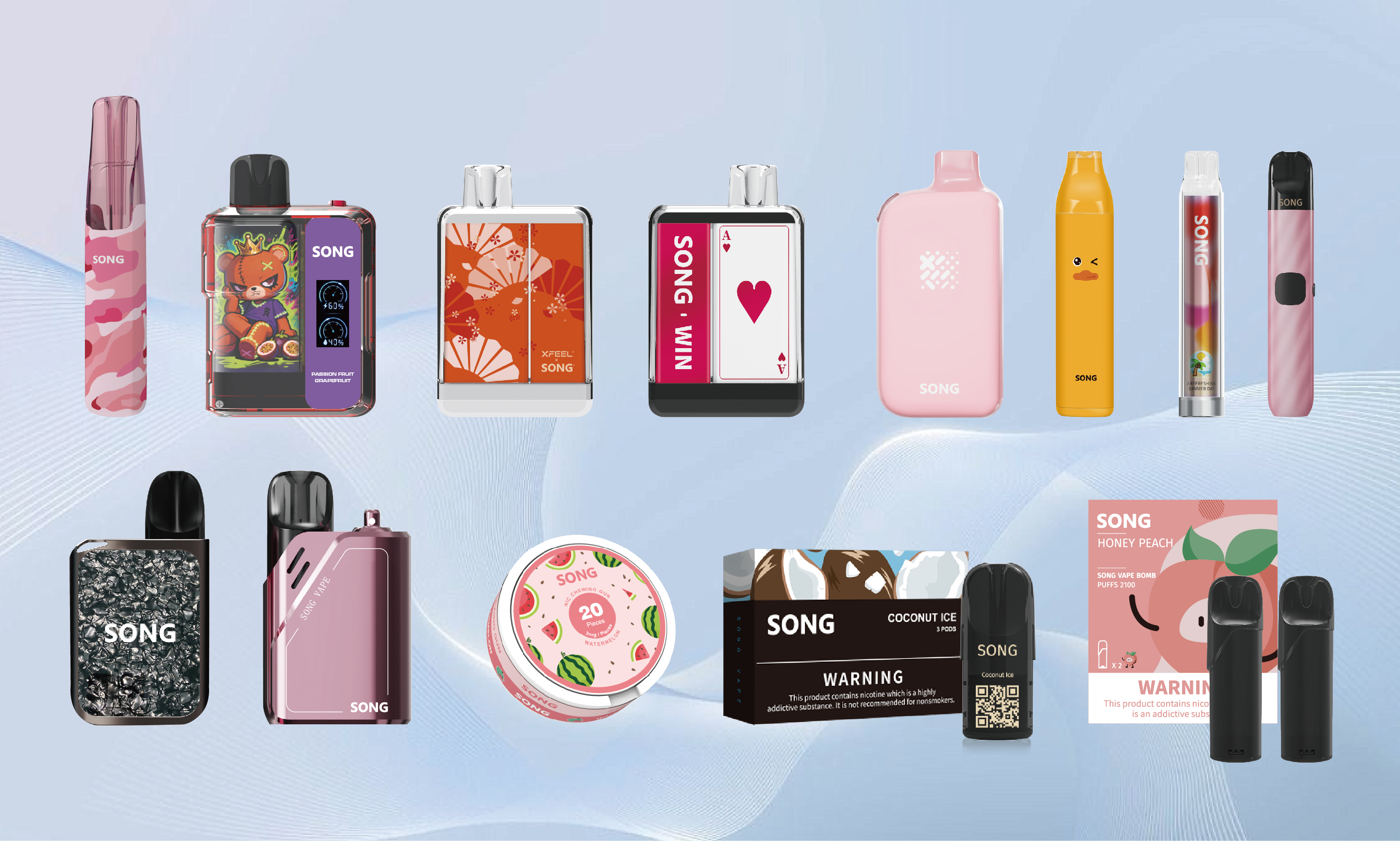
SONG VAPE Introduction
SONG VAPE is a professional brand specializing in fruit flavor e-cigarettes. As a leading entity in the industry, we focus on providing high-quality disposable vapes and a wide range of vaping supplies. We are a trusted partner for businesses seeking a reliable electronic cigarette wholesale supplier. Our products are popular in markets requiring premium fruit flavor vape options, and we are a preferred choice for usa online vape stores looking to stock diverse, compliant, and flavorful products. For all your wholesale vaping supply needs, SONG VAPE is your dedicated partner.
